

Pascha 2026
THE PEACE OF THE RISEN CHRIST IN A TROUBLED WORLD
I
Let us pause at the first words the Risen Christ spoke when He appeared before His disciples. He did not say to them “victory,” nor “glory,” nor “power,” but He said: “Peace be with you.” (Jn 20:19). He entered the room where they were shut in out of fear and bestowed upon them that which the world can never give: the peace that does not depend on conditions, geopolitical balances, nor human accord, but “the peace of God, which surpasses all understanding” (Phil 4:7), a deep spiritual peace which comes first and foremost from the reconciliation of the human person with God and then extends to all people.
Today the world is troubled. Bloody wars continue to cause death and suffering. The fear of tomorrow covers entire nations. Uncertainty knocks everywhere. In the midst of this storm, the Risen Christ repeats: “Peace be with you.” This is not merely a wish of social courtesy, but an ontological reality. Death has been defeated. And if death has been defeated, what can trouble us any longer? The peace of Christ is not the absence of problems; it is the presence of God within problems. Upon the Cross of Golgotha, Christ confronted all the passions of humanity. The greed for money betrayed Him through Judas. Envy handed Him over to Pilate. Trembling and corrupted power condemned Him. Pride mocked Him. Hatred nailed Him to the Cross. All the passions erupted upon Him with fury, as if the world wanted to kill God Himself.
And yet, upon the Cross, precisely where evil thought it had triumphed, Christ did not seek revenge. He cried out: “Father, forgive them, for they know not what they do.” (Lk 23:34). With these words He did not simply defeat death. He defeated the vicious cycle of evil. He defeated the logic of vengeance that feeds every war, every hatred, every dark clash in history. The Resurrection bears witness that love is stronger than death; that forgiveness destroys evil, while revenge multiplies it. The Risen Christ did not come to punish His crucifiers. He came to save them and to bring them peace. And this is the greatest victory in history.
II
In the age in which we live, we face a new form of death: the numbness of indifference; the hardening of the heart; the spiritual drought of a society that has forgotten God, not because faith was forbidden, but because society chose to ignore Him. The clash of invisible convictions continues to destroy visible lives. “For what does it profit a man to gain the whole world – Christ tells us – and forfeit his soul?” (Mt. 16:26). These words are timelier than ever. We live in an era when the human person relentlessly pursues material goods, security, and social status and yet feels emptier, lonelier, more unfulfilled, and more troubled than ever.
Yet the Resurrection reveals to us a great truth: whoever has Christ in his heart, lacks nothing. And not only spiritually. The Lord who cared to feed five thousand with five loaves, the Lord who turned water into wine, the Lord who said, “Seek first the Kingdom of God and all these things shall be added unto you.” (Mt 6:33), this Lord does not leave His children without what they need. He cares for both body and spirit; He gives both bread and peace. Fullness is not found in the accumulation of wealth, but in the relationship with the Creator. Only near Him can we find peace, for only He is our peace (Eph 2:14).
We know what Resurrection means, not only theoretically, but from lived experience. Our Orthodox Church passed through its own Golgotha. For decades, they tried to erase every trace of faith. Churches were destroyed, clergy were martyred, the word “God” was forbidden. The Church appeared dead, buried in a sealed tomb. And yet, she rose again. The stone was rolled away. Faith blossomed anew from the ruins. Churches were rebuilt. Communities were recreated. This was not a human achievement; it was the power of the Risen Christ acting within history.
III
The Church makes an appeal once again for Resurrection – this time for the Resurrection of every soul. The Risen Christ stands before us today, as He stood before Thomas, and shows us His wounds. He does not hide them. He does not remove them. He bears them forever upon Himself, as an eternal testimony of love. These wounds say: “I loved you so much that I accepted the gravest pain for you.” Every person, every soul, is so unique, so unrepeatable, that God would have come even if it were for one person alone.
Beloved brothers and sisters! In this troubled world, only one certainty suffices: Christ is risen and lives. And if Christ lives, we also live. And if we live in Christ, then neither death, nor evil, nor poverty, nor persecution can separate us from His love and His peace. “The day of the Resurrection of our Lord Jesus Christ – writes Saint John Chrysostom – is the foundation of peace.” For from the Resurrection of Christ comes the Peace of God. The Resurrection and the Peace of God is not an abstract dogma, but a personal calling.
Let us, therefore, respond to the call “Peace be with you” with our whole life. Let us ourselves become peacemakers in a world being destroyed by hatred, greed, and selfishness. But to become peacemakers, we must first have peace within ourselves. “Acquire peace in your heart” – says Saint Seraphim of Sarov – “and thousands of people around you will be saved.” For there is no peace where evil reigns, but only where God is present. Let us find this peace of God in our hearts and then spread it everywhere, together with the joyful message that Christ is Risen and has bestowed upon the world life and eternal peace.
With love in the Risen Lord,
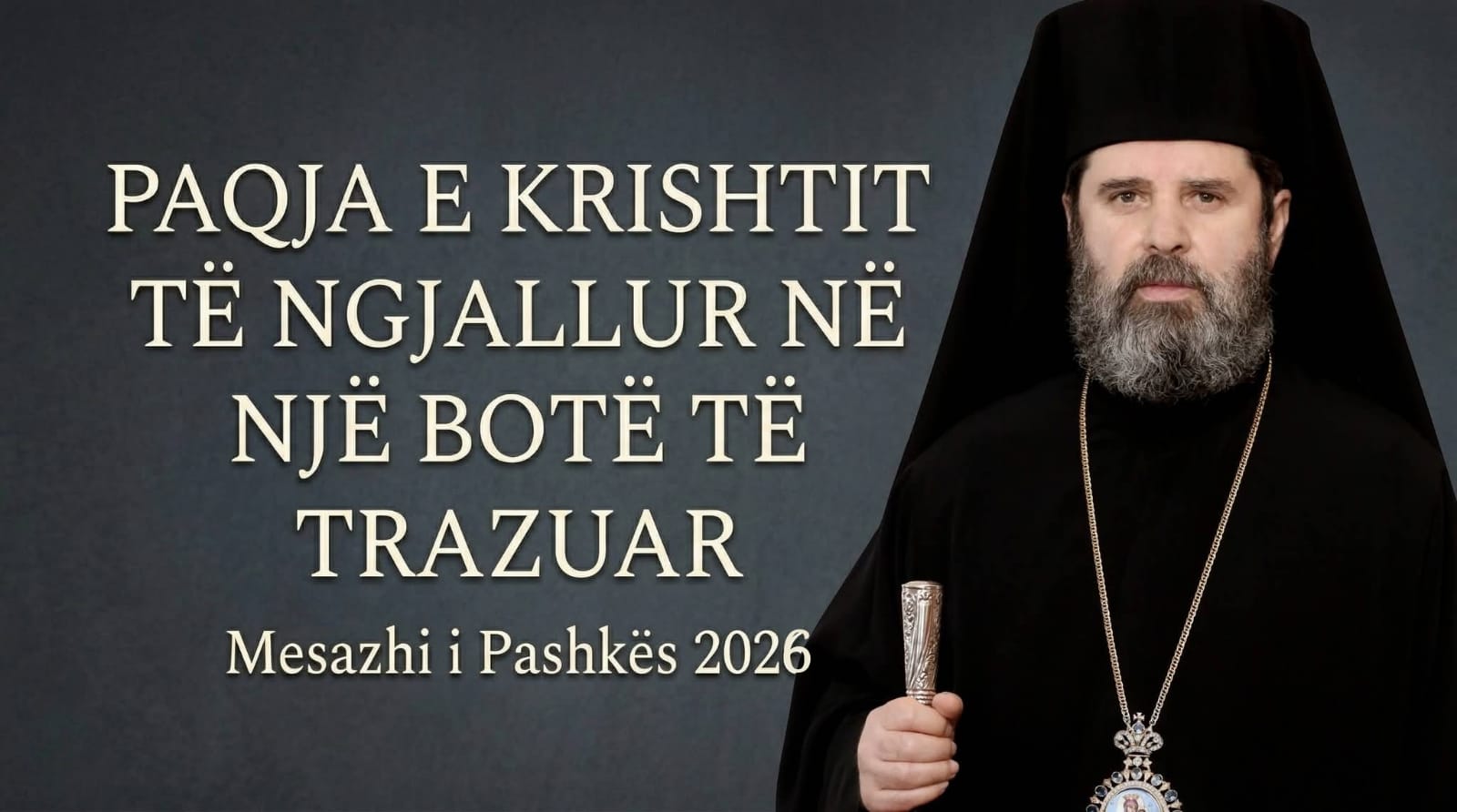
† Joani
Archbishop of Tirana, Durrës and All Albania