

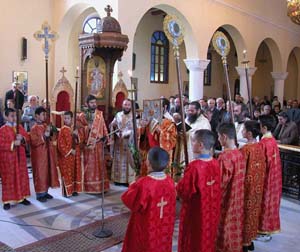
 When the Church, which means literally the gathering or assembly of people who are called together to perform a specific task, assembles as God’s People to worship, this gathering is called the liturgy of the Church. As a word liturgy means the common work or action of a particular group of people for the sake of all. Thus the divine liturgy of the Christian Church means the common work of God done by the people of God.
The liturgy of the Old Testament people was the official worship in the temple of Jerusalem according to the Mosaic Law, as well as the annual feasts and fasts and the private prayers and services held by the Israelites at home or in the synagogues. Synagogues by definition are houses of gathering; they are not temples since according to the Law there was just the one temple in Jerusalem where the priestly worship was conducted. In the synagogues the Israelites gathered for prayer and scriptural study, preaching, and contemplation of the Word of God.
In the New Testament Church the liturgy is centered in the person of Christ and is primarily a “christening” of the Old Testament liturgical life. The Christian Church retains the liturgical life of the Old Testament in a new and eternal perspective. Thus, the prayers of the Old Testament, the scriptures and the psalms, are read and sung in the light of Christ. The sacrifice of the Body and Blood of Christ replaces the Old Testament sacrifices in the temple. And the Lord’s Day, Sunday, replaces the old Jewish sabbath which is Saturday.
The Jewish feasts also take on new meaning in the Christian Church with the central feast of Passover, for example, becoming the celebration of Christ’s death and resurrection; and the feast of Pentecost becoming the celebration of the coming of the Holy Spirit which fulfills the Old Testamental Law. The Christian liturgical year is also patterned after the Old Testamental prototype.
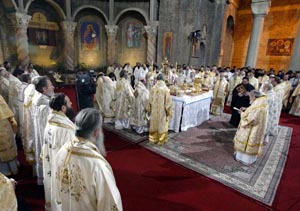 From the basic foundation of the Old Testament liturgy the Church developed its own sacramental life with baptism in the name of the Holy Trinity, chrismation, holy communion, marriage, repentance, healing and the Churchly ministry and priesthood taking on specifically Christian forms and meaning. In addition, a great wealth of specifically Christian prayers, hymns and blessings were developed, together with specifically Christian feasts and celebrations in remembrance of New Testamental events and saints.
The living experience of the Christian sacramental and liturgical life is a primary source of Christian doctrine. In the liturgy of the Church, the Bible and the Holy Tradition come alive and are given to the living experience of the Christian people. Thus, through prayer and sacramental worship men are “taught by God” as it was predicted for the messianic age (Jn 6:45).
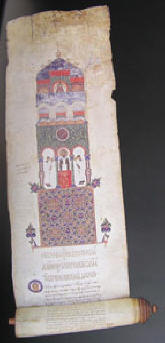 In addition to the living experience of the liturgy, the texts of the services and sacraments provide a written source of doctrine in that they may be studied and contemplated by one who desires an understanding of Christian teachings. According to the common opinion of the Orthodox Church, the sacramental and liturgical texts—the hymns, blessings, prayers, symbols, and rituals—contain no formal errors or deformations of the Christian faith and can be trusted absolutely to reveal the genuine doctrine of the Orthodox Church. It may well be that some of the historical information contained in church feasts is inaccurate or merely symbolical, but there is no question in the Church that the doctrinal and spiritual meaning of all of the feasts is genuine and authentic and provides true experience and knowledge of God.